How Lobby Personalization Lifted Monetization +14.5% in a Mature Geo and Boosted Engagement and Retention
Not every market gets the same attention, but every player deserves the same experience
Multi-geo operators know the reality: some markets get a dedicated CRM team, regular campaign optimization, and close attention to player behavior. Others (smaller or newer) run on leaner resources. Because the team's capacity and budget have to be allocated where the impact is clearest first.
That's a reasonable strategy. But it does mean the player experience in a smaller geo is less tailored: the same lobby, the same game list for everyone, until the team has enough capacity to invest in optimization there. The question is: can you give that market personalized attention earlier, without adding headcount? Can AI fill that gap while the team focuses where it needs to?
The setup: one operator, two very different markets
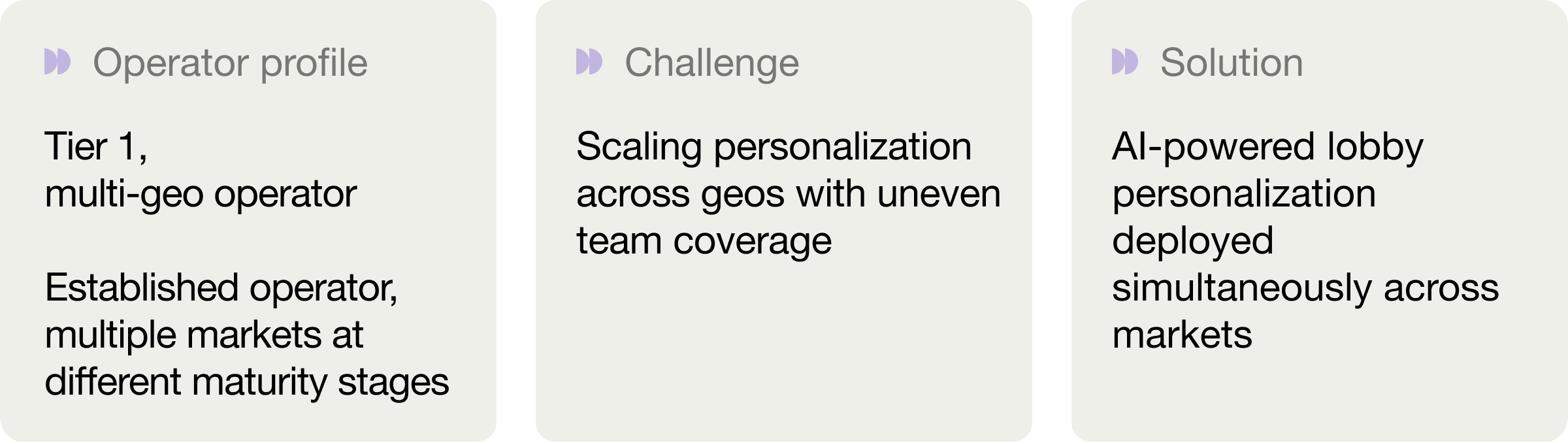
An established Tier 1 operator running multiple geos deployed The Playa's lobby personalization simultaneously across its markets. Two of those geos tell a particularly interesting story:
Geo 1: the operator's largest market. A strong, experienced CRM team had been optimizing player engagement for years. Retention was already well managed. The team knew their players and had built effective processes around segmentation and lobby curation and player behavior overall.
Geo 2: a smaller market with fewer resources allocated to it. The same platform, the same game catalogue, but without the same level of dedicated CRM effort. Players got a less personal experience.
Both geos received the same AI personalization, deployed at the same time, running the same model. The question was: what happens when you add the same layer of intelligence to markets at very different stages?
The A/B test: 6 weeks, across both geos
The operator ran a 6-week A/B test with balanced groups across both markets:
- Control group: Standard lobby with manually curated recommendations.
- Test group: The Playa's AI recommendations, personalized per player.
Same test design, same duration, same product. The only variable was whether the "Top Games" block was curated by the team or by AI.
The results: two markets, two different stories
Geo 1 (largest market) - deeper sessions, higher monetization
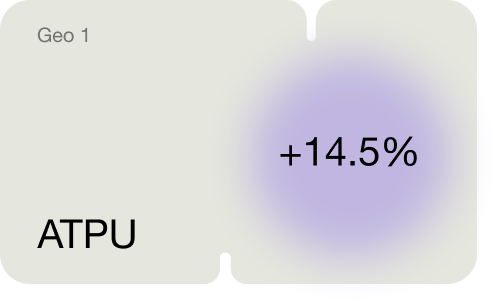
In Geo 1, the CRM team had already built strong retention, engagement metrics like days per user and games per player were already at a high level and stayed steady.
Where AI personalization made its mark was session quality:
ATPU grew by 14.5%, average bet by 18.4%, and average deposit by 11.8%. Players were engaging at the same frequency, but spending more per session because the AI matched them with games that fit their preferences better. In a market that was already performing well, that's a meaningful layer of additional value.
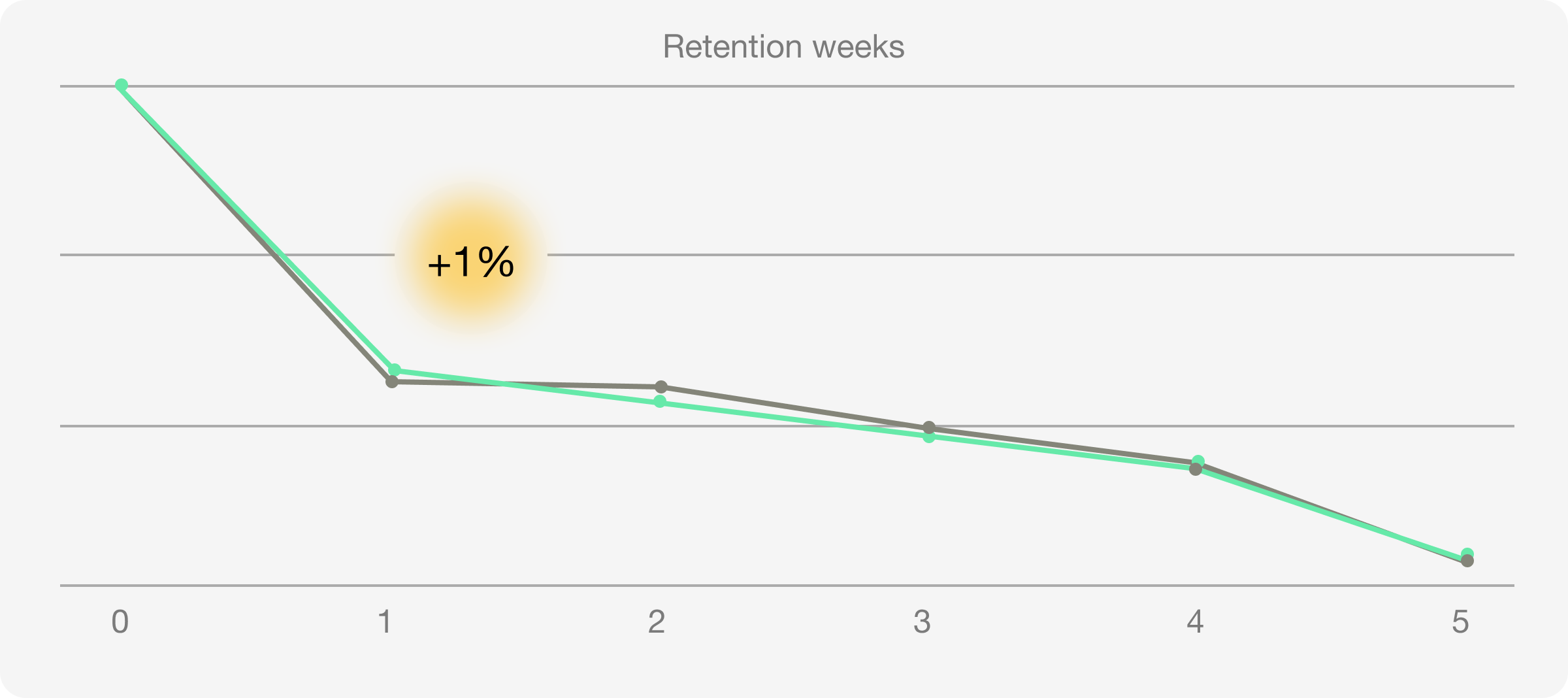
The weekly retention curve confirmed the picture: both groups tracked almost identically throughout the test. In a geo where the CRM team had already built strong retention, AI personalization didn't move the needle on how often players came back. Its impact was in what happened during each session, not how many sessions there were.
Geo 2 (smaller market) - the AI filled the gap
In Geo 2, where fewer resources were allocated to retention, the picture was completely different. AI personalization moved everything:

Days per user jumped by 15.2% and games per player by 15.5%. Players were exploring the catalogue far more actively and coming back more often. ATPU by 9.7%.
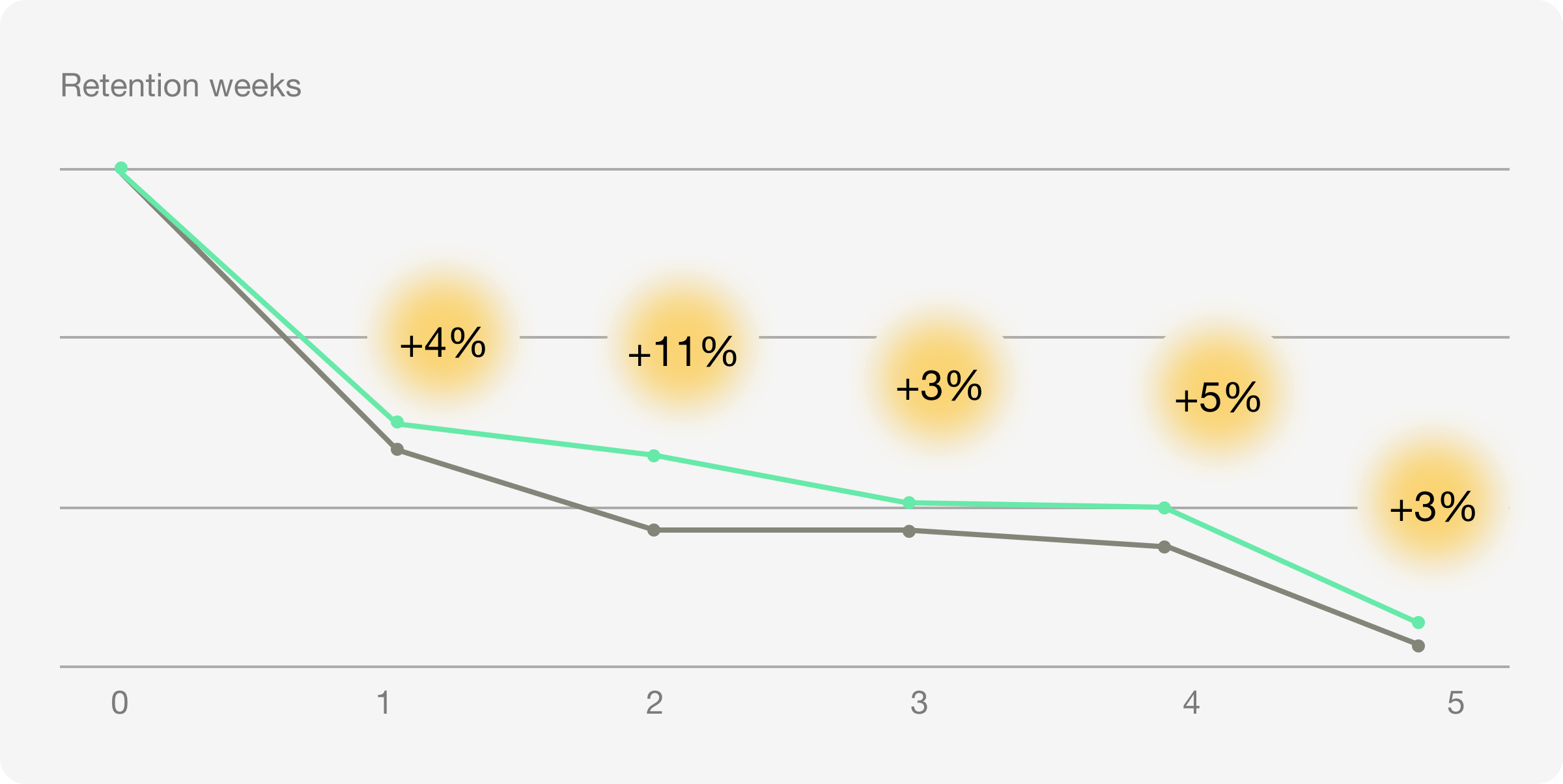
Weekly retention told the same story. The personalized group held a consistent edge over control throughout the test period: +4 p.p. at week 1, peaking at +11 p.p. by week 2, and sustaining a +3–5 p.p. gap through weeks 3–5. In a market with less CRM attention, AI personalization didn't just boost single-session metrics, it kept players coming back.
Where Geo 1 saw monetization gains on top of strong engagement, Geo 2 saw gains across the board, engagement, discovery, and revenue. The AI personalization helped bring players back more often and explore the catalogue more actively, even before the market had a fully established CRM operation behind it.
What the contrast reveals
The two geos tell the same story from different angles:
In a mature market with a strong team, AI personalization adds a layer that manual curation can't replicate: individual-level game matching that makes each session more valuable. The team already kept players coming back; the AI increased the value of every session, a direct impact on player LTV.
In a market without dedicated attention, AI personalization doesn't just optimize. It closes the gap. It gives every player a personalized experience regardless of whether the team has the bandwidth to focus on that market. The +15.2% increase in days per user and +15.5% in games per player shows that players responded to a lobby that finally adapted to them.
The takeaway for multi-geo operators: personalization doesn't just help your best market get better. It lifts your low priority markets to a level that would require significant team investment to achieve manually.
Common concerns
"Our primary geo is already well optimized, AI won't add much."
Geo 1 confirms engagement stays steady, but +14.5% ATPU and +18.4% average bet on top of an already strong market is real money. Players have a finite budget of time and money each month, and they typically spread it across several products. Better game matching means more of that share of wallet goes to your platform. Players spend more per session because they're finding games that keep them engaged longer. That's the monetization depth that a static lobby leaves on the table.
"Our smaller markets don't justify the investment."
Geo 2 saw +9.7% ATPU with no additional team effort. That's the point. AI personalization scales without headcount. Markets that don't justify a dedicated CRM team can still get a personalized player experience.
"You can't apply the same model to different markets."
The model is trained separately for each geo. It recognizes the country identifier and learns behavioral patterns specific to that market. Players in different countries play differently, and the model captures those differences rather than averaging them out. Same architecture, same deployment process, but each geo gets a model tuned to its own player behavior. That's why it produced different results in Geo 1 and Geo 2: not because it applied the same logic blindly, but because it found what works in each market individually.
Running multiple geos with uneven team coverage?
See how AI personalization performs across your markets, pilot in 2-4 weeks.