How Newbies Profiling with a Custom Journey Lifted ATPU by 12.8%
New players aren't one audience, they're several
The industry standard for new player onboarding looks roughly the same everywhere: new player comes in, gets a welcome bonus, enters a standard communication flow, and either converts or doesn't. The CRM sequence is the same for everyone, same timing, same messages, same mechanics.
The industry standard for new player onboarding looks roughly the same everywhere: player comes in, gets a welcome bonus, enters a communication flow, and either converts or doesn't. The CRM sequence is the same for everyone, same timing, same messages, same mechanics. That's not a criticism of any specific team, it's how the tooling works today.
It's not that operators don't want to differentiate. It's that they can't, not with standard tools. A new player has almost no history on the platform. There's nothing to segment by: no deposit patterns, no game preferences, no lifecycle stage. Traditional CRM segmentation needs data that doesn't exist yet in the first days after registration.
So everyone gets the generic flow. Meanwhile, new players actually behave very differently from each other from the start. Some deposit immediately and dive into high-stakes games. Others take their time, exploring the catalogue, testing small bets, studying the product before committing. These aren't just behavioral quirks. They signal entirely different needs, and rule-based segmentation can't address them.
The operator's hypothesis: what if we designed journeys for how players actually behave?
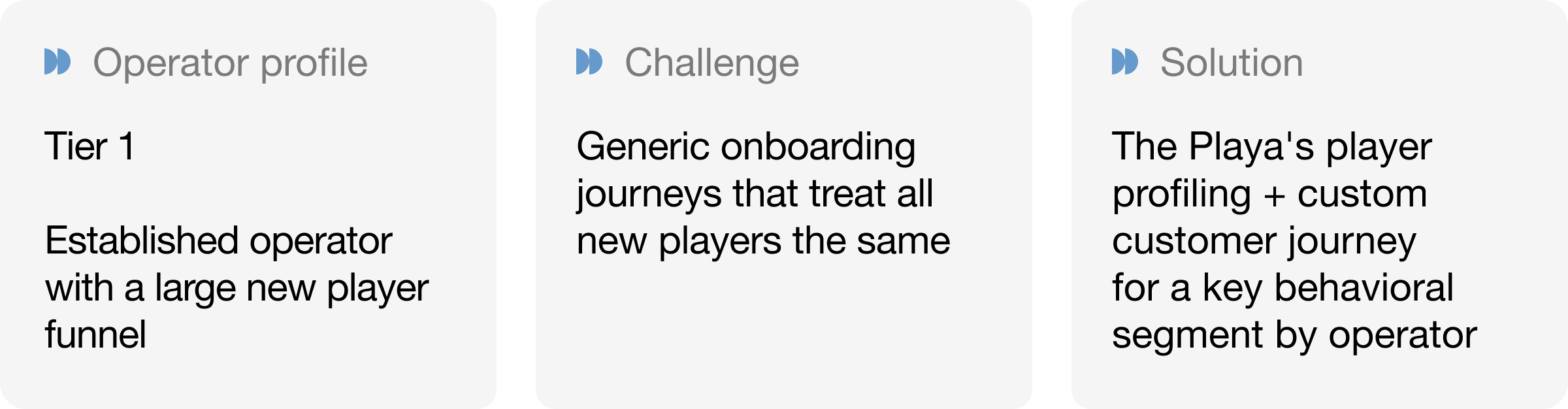
A Tier 1 operator with a large new player funnel wanted to move beyond generic onboarding. Their existing customer journey flows were functional but standard: the same sequence of bonuses, communications, and nudges for every new sign-up.
The team came to The Playa with a specific question: what if we could identify distinct behavioral types among new players early enough to tailor their onboarding experience?
The Playa's profiling system analyzes how each player interacts with the platform in real time, playing frequency, game type preferences, risk appetite, bet sizing, deposit rhythm, and how all of these change over time. Based on these signals, the system assigns a behavioral profile within the first 24 hours of a player's activity, early enough to route them into the right journey from the start. The profile continues to update as new data comes in.
The operator used this profiling to identify distinct player types within their new user base and chose to test a custom journey for one of them.
The Focus: "Researchers" - cautious players who study before they commit
Among the profiles identified, one stood out: Researchers. These are players who take a careful, exploratory approach to the platform. They don't rush to deposit or chase bonuses. They study the product, browsing games, testing mechanics, watching how things work before deciding to engage more deeply.
Researchers represent roughly 20% of the new player base. In a standard RFM segmentation, they look uninteresting: active and play frequently, but with low volume. A CRM team looking at deposit size or bet amounts would likely deprioritize them.
Yet profiling revealed a different picture: this segment accounts for a huge part of GGR. The players that RFM would overlook turn out to be disproportionately valuable, they just need a different approach to unlock that value.
The custom journey: built around how researchers actually engage
The operator designed a new customer journey specifically for Researchers, active during the first 16 days from registration. The concept supported their exploratory nature instead of fighting it. A few examples of what this looked like in practice: achievements that reward exploring different product types, quests that encourage trying new game categories, and win-focused communications that highlight successful outcomes rather than pushing deposits.
The key principle: instead of pushing Researchers to behave like impulse players, the journey met them where they were and guided them deeper into the product at their own pace.
The operator designed a new customer journey specifically for Researchers, active during the first 16 days from registration. The concept supported their exploratory nature instead of fighting it. A few examples of what this looked like in practice: achievements that reward exploring different product types, quests that encourage trying new game categories, and win-focused communications that highlight successful outcomes rather than pushing deposits.
The key principle: instead of pushing Researchers to behave like impulse players, the journey met them where they were and guided them deeper into the product at their own pace.
The A/B test: 12 weeks, researchers only
The operator ran a 12-week A/B test across the Researcher segment:
- Control group: Standard onboarding CJ, the same flow every new player receives.
- Test group: The custom Researcher CJ, tailored mechanics and communications for the first 16 days.
Both groups were identified as Researchers by The Playa's profiling. The only difference was which journey they entered.
To validate that the results came from the targeting (not just from having a new CJ), the operator also applied the same Researcher journey to a different, non-Researcher profile. If the lift were simply about a fresher flow, it would show up there too. It didn't. The uplift was specific to Researchers receiving a journey designed for how they behave.
The results
The custom journey delivered clear, sustained uplift across the metrics that matter:
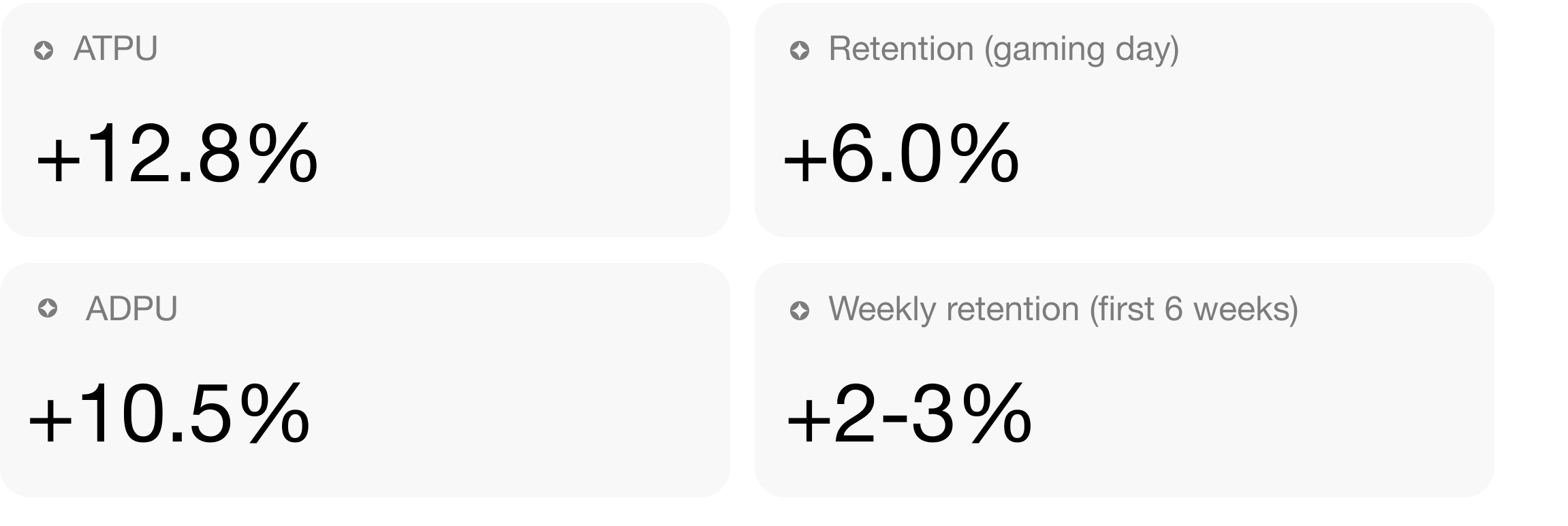
Average turnover per user grew by 12.8% and average deposits per user by 10.5%. Retention on gaming days increased by 6.0%, with weekly retention in the first 6 weeks of activity rising by 2-3 percentage points each week.
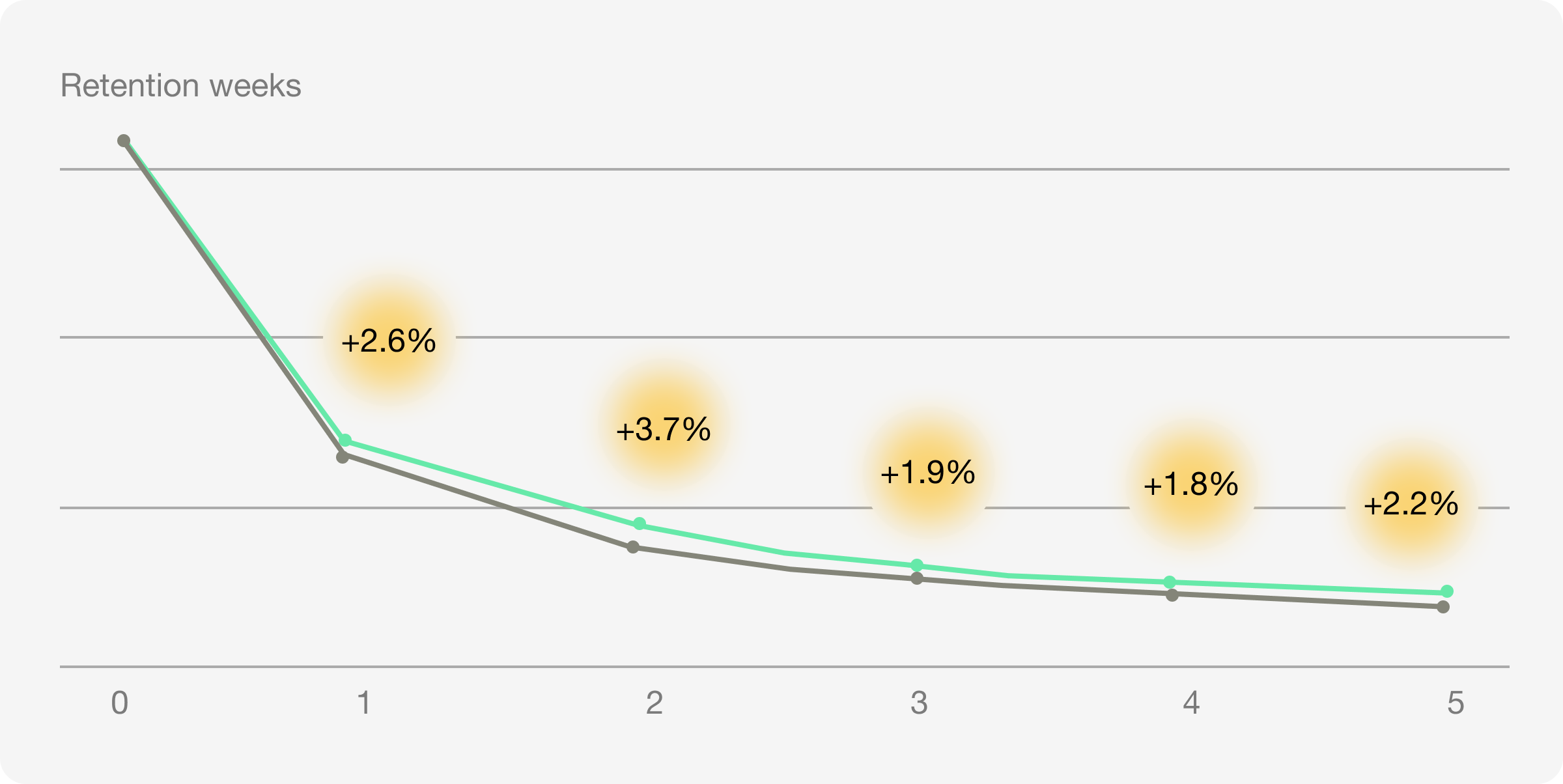
Two details matter beyond the headline numbers. First, the ADPU lift appeared during the CJ period and held through most of the test. The effect didn't fade when the custom journey ended. Second, ATPU showed the same pattern: growth during the CJ that persisted afterward. The custom journey didn't just temporarily boost metrics. It shaped how Researchers engaged with the platform going forward.
Fair questions
"We already segment our new players." Segmentation by deposit amount or game type is a start, but it doesn't capture behavioral patterns like risk appetite, exploration speed, or how a player's engagement evolves over their first days. Researchers look unremarkable in a basic segmentation, they're not high depositors yet. "Building custom journeys for each segment isn't scalable." This test focused on a single profile (Researchers), and it already moved ATPU by 12.8%. You don't need to customize every segment at once. Start with the one that has the highest value-to-attention gap and build from there. The profiling tells you where to focus first.
"The lift is just from the enhanced bonuses, not the profiling." Bonus rates stayed within normal range. The operator tracked this explicitly. The uplift came from giving Researchers a journey that matched how they engage, not from spending more on bonuses. The effect persisting beyond the 16-day CJ window confirms it wasn't bonus-driven.
What this means for operators
Generic onboarding leaves value on the table, especially among players who don't fit the "deposit fast, play fast" mold. Researchers are one example of a lot: high-value players whose cautious behavior makes them invisible to standard segmentation and underserved by standard journeys.
Profiling changes the question from "how do we get new players to convert faster?" to "how does each type of player naturally engage, and how do we build an experience that supports that?" The answer produces better retention, higher LTV, and (as this case shows) results that compound beyond the initial touchpoint.
Every operator's player base contains behavioral types that respond to different approaches. The question is whether you can see them early enough to act on it.
Want to discover the behavioral profiles hiding in your new player data?
Start with a profiling analysis and see which segments carry disproportionate value.