New Player, New Lobby: How a Tier 1 Multi-Geo Operator Grew Newbie Turnover 31% by Personalizing Game Recommendations from Day 2
New players are the hardest segment to personalize for, and the easiest to lose
The first days on a platform are when a player's habits get set. If the first thing a new player sees, day after day, is the exact same static lobby that every other new player sees, that's the experience they learn to associate with the product, generic, impersonal, the same regardless of what they actually clicked on yesterday.
Most operators accept this as unavoidable. A new player has no betting history, no session pattern, nothing yet for a recommendation engine to learn from, so the default is to leave personalization for later and give everyone the same lobby until enough data accumulates. It's a reasonable trade-off on paper. In practice, it means the newest, most impressionable segment of players gets the least tailored experience on the entire platform, at exactly the moment when their habits are forming.
The underlying hypothesis behind this test was simple: a new player who opens the lobby and sees something that shifts based on what they did yesterday, finds the product more interesting than one who sees the same static screen on day 1, day 2, and day 10. And a player who's more interested plays more, explores more of the catalogue, and comes back more often, not because of a bonus or a nudge, but because the product itself responded to them. If that's true, the earliest metrics to move should be exactly the ones this test measured: turnover, days active, games played, GGR, all a byproduct of a player who's simply more engaged with what's in front of them.
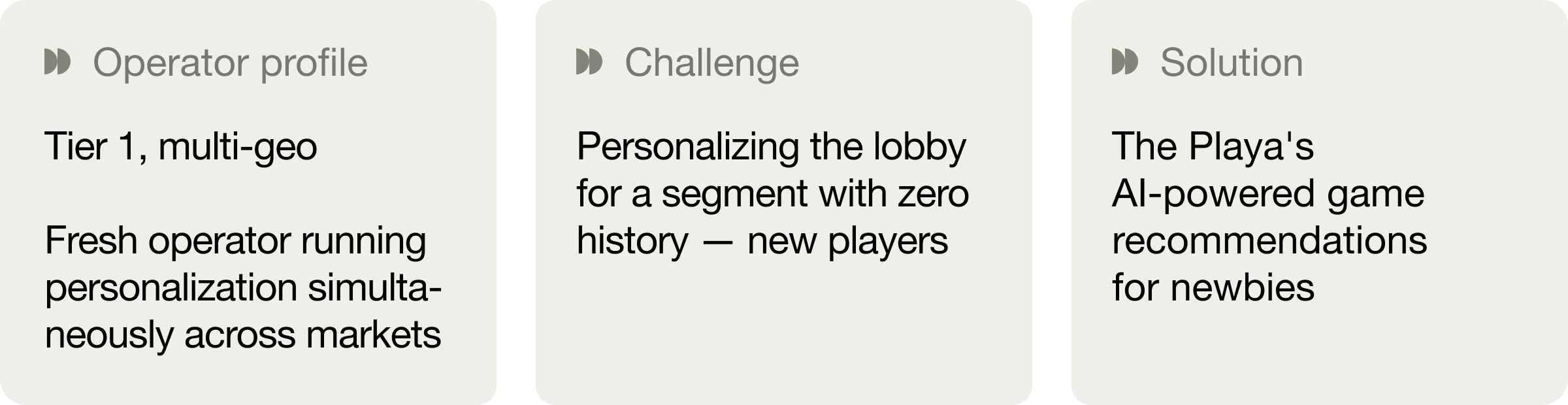
A Tier 1 operator running across multiple European markets wanted to test that hypothesis directly, on its newest, least-understood cohort: newbies, from their second day in, across every geo it operates in simultaneously, rather than waiting the usual months for a mature player profile to form.
The solution: personalizing from day 2, not month 2
The operator deployed The Playa's AI-driven game recommendations in the lobby's Recommended section for new players, using only the earliest available signals, first game choices, early session behavior, initial betting patterns, instead of waiting for a mature profile to form. The rest of the lobby stayed untouched; only the recommendation logic changed.
The test ran as an extended 13-week 50/50 A/B split across three markets simultaneously, isolating the newbie cohort specifically to see whether early personalization could move the needle before any long-term behavioral profile existed.
Control group: Standard lobby with a default game selection, the same for all new players.
Test group: The Playa's AI recommendations, personalized per newbie from their second day in.
The results: three markets, three different maturity curves
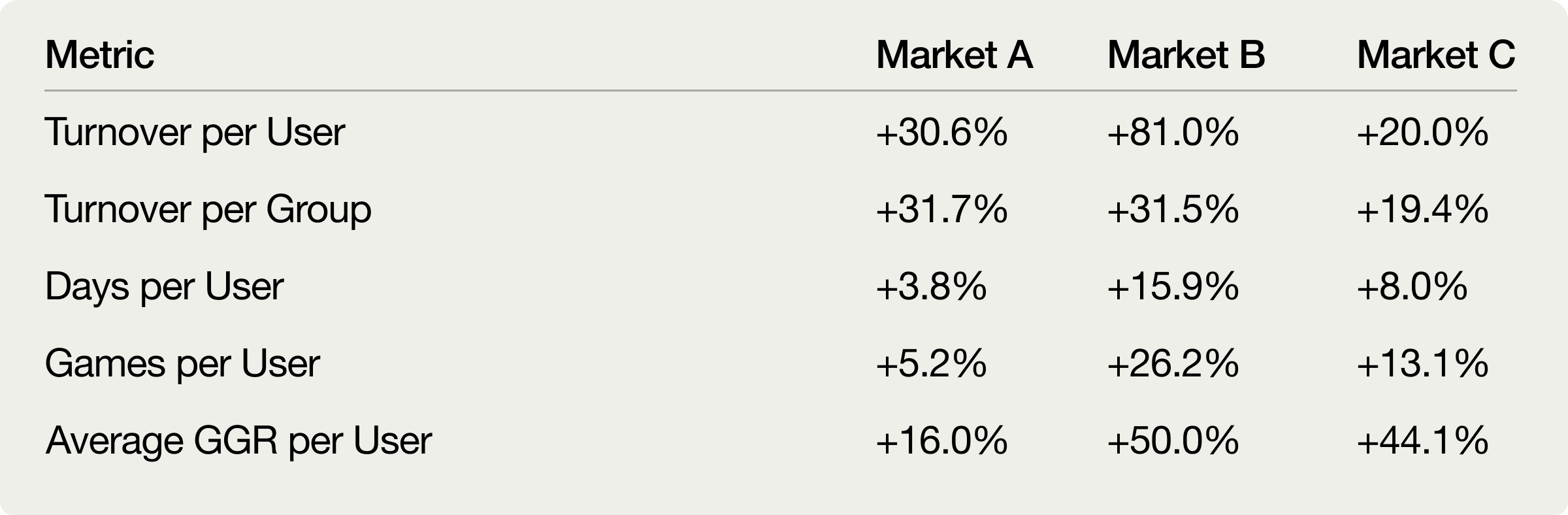
The size of the lift varied by market, and that difference tells its own story.
Market B saw the biggest jump in engagement, days per user +15.9%, games per user +26.2%, GGR per user +50.0%, newbies there explored noticeably more of the catalogue and came back more often.
Market A, the operator's largest and most established market, delivered the steadiest read on turnover: +30.6% per user, the clearest and most reliable result of the three.
Market C, the newest market in the rollout, moved in the same direction across every single metric, a strong early signal in a market that's still building its newbie base.

Across all three markets, every one of the five metrics measured, turnover per user, turnover per group, days per user, games per user, and GGR per user, moved in the same direction for the personalized newbie group. Not one metric reversed in any market: this wasn't a single strong result carrying a mixed dataset, it was the same pattern repeating across an entire multi-geo rollout.
Questions worth asking
"An 81% swing in one market looks like an outlier, not a trend."
Fair question. Newbie cohorts are small, and a handful of high-spending new players can swing an average hard in either direction. That's why this case reports five metrics per market instead of one big number, and leads with Market A, where the turnover gain held up most reliably, not the market with the biggest headline figure.
"Why does the size of the lift vary so much market to market?"
Each market is at a different point in its own growth curve, and newbie cohorts are the smallest, most volatile group an operator has. Rather than average the three into one number, each is reported on its own terms, the direction was the same everywhere, the scale wasn't.
"Isn't it too early to personalize a player you've barely seen play?"
That's exactly the assumption this test was built to challenge. The model doesn't wait for a mature profile, it starts from day 2 using the earliest signals available: first game choices, session length, initial betting patterns. The results across all three markets are the proof that even a thin signal is enough to move outcomes, waiting for "enough data" just costs engagement during the exact window when player habits are forming.
What this means for operators
Personalization doesn't have to wait for history to accumulate. Even with nothing but the earliest in-session signals, an AI recommendation layer moved core financial and engagement metrics for brand-new players, in the operator's most mature market, in a statistically defensible way.
Running personalization across a multi-geo newbie funnel? Test how it performs on players who have almost no history yet, pilot in 2-4 weeks.